Korean alphabet
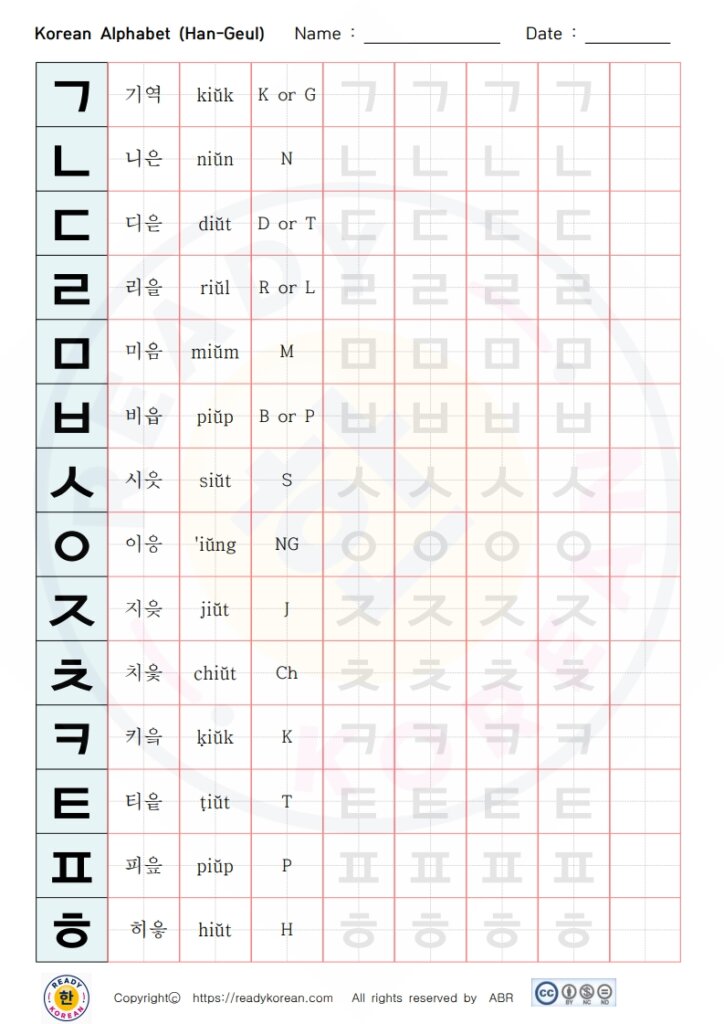
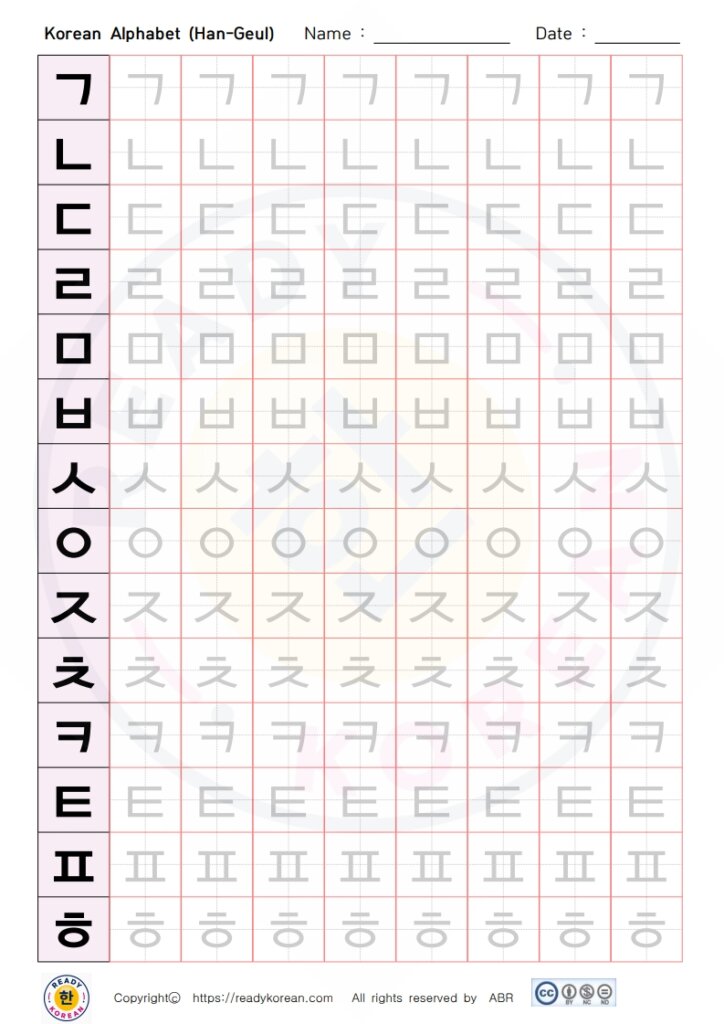
Hangeul for beginners 14 Consonants PDF
If you are just beginning your journey into the Korean language, the first and most important step is learning the alphabet, known as Hangul. Unlike many languages that use complex symbols, Hangul was scientifically designed to be easy to learn.
In this guide, we will break down the Korean consonants to help you get started with reading and writing.
1. The Basics: Core Consonants
There are 14 basic consonants in the Korean alphabet. They are categorized by the shape of the mouth and tongue when pronouncing them.
| Letter | Romanization | Approximate English Sound |
| ㄱ | g/k | Like ‘g’ in “go” or ‘k’ in “sky” |
| ㄴ | n | Like ‘n’ in “no” |
| ㄷ | d/t | Like ‘d’ in “do” or ‘t’ in “stop” |
| ㄹ | r/l | Between ‘r’ and ‘l’ (tongue flicks the roof of the mouth) |
| ㅁ | m | Like ‘m’ in “mom” |
| ㅂ | b/p | Like ‘b’ in “boy” or ‘p’ in “spot” |
| ㅅ | s | Like ‘s’ in “sun” |
| ㅇ | ng/silent | Silent at the start of a syllable; ‘ng’ at the end |
| ㅈ | j | Like ‘j’ in “jump” |
| ㅊ | ch | Like ‘ch’ in “chair” |
| ㅋ | k | Like ‘k’ in “kite” (aspirated) |
| ㅌ | t | Like ‘t’ in “top” (aspirated) |
| ㅍ | p | Like ‘p’ in “park” (aspirated) |
| ㅎ | h | Like ‘h’ in “hat” |
2. Key Concepts to Remember
- The “Silent” Consonant (ㅇ): You might notice that every Korean syllable must start with a consonant. When a syllable starts with a vowel sound, you place the “ㅇ” at the beginning as a placeholder. In this position, it is silent. However, when it appears at the end of a syllable, it sounds like the “-ng” in “song.”
- Aspiration (Breath): Notice the letters ㅋ (k), ㅌ (t), ㅍ (p), and ㅊ (ch). These are “aspirated” sounds. To pronounce them correctly, imagine a small puff of air escaping your mouth when you say them.
- The R/L Sound (ㄹ): This is often the trickiest for beginners. It is not a hard “R” like in English. Instead, your tongue should briefly tap the ridge behind your upper teeth. Think of it as a very soft “L” or “R.”
3. Double Consonants
In addition to the 14 basic consonants, there are 5 “tense” or double consonants. These are produced with more tension in your throat.
- ㄲ (kk)
- ㄸ (tt)
- ㅃ (pp)
- ㅆ (ss)
- ㅉ (jj)
These sounds are shorter and sharper than their single counterparts. Think of the difference between “s” in “sun” (ㅅ) and the “ss” in “glass” (ㅆ).
Why learn Hangul first?
Many beginners rely on Romanization (writing Korean in English letters), but this can actually slow down your progress. Because English letters cannot perfectly capture Korean sounds, learning the actual consonants is the most effective way to improve your pronunciation and truly understand the rhythm of the language.
Practice Tip: Try writing your name using Hangul characters! Even if it is just a rough phonetic approximation, it is the best way to memorize the shape and sound of each consonant.