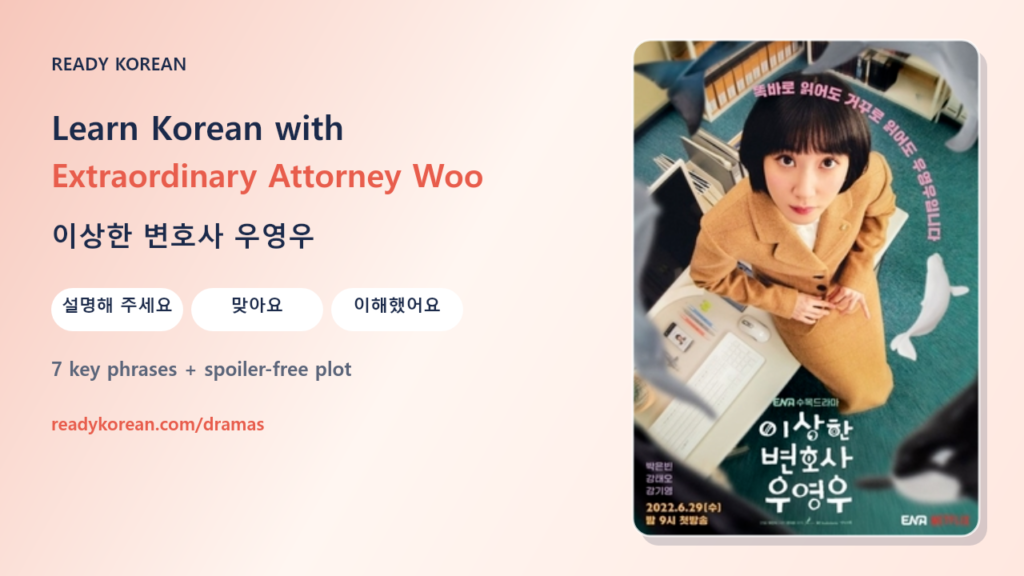
Extraordinary Attorney Woo (이상한 변호사 우영우) became a global hit for good reason: the story is moving, the legal cases are clear, and the main character speaks in short, memorable lines. That makes it excellent for Korean learners who want polite, precise speech.
This post gives you a spoiler-light plot overview, 7 useful phrases you can practice today, one politeness tip, and links to practice more on Ready Korean.
Short plot (minimal spoilers)
Extraordinary Attorney Woo is a 2022 ENA legal drama starring Park Eun-bin. Woo Young-woo is a brilliant lawyer on the autism spectrum. She joins a major law firm and uses her sharp memory and logic to win cases—while learning how to navigate office politics, friendship, and romance.
Each episode focuses on a case, so vocabulary repeats in familiar patterns: explaining facts, asking questions, agreeing, disagreeing, and asking for help. For learners, that structure is gold.
Want the poster, cast list, and which Ready Korean lessons connect to this drama? Open the drama page here:
→ Extraordinary Attorney Woo on Ready Korean Dramas
7 useful phrases from drama-watching Korean
These phrases fit courtroom, office, and daily-life scenes in the show—and beyond.
1. 네, 알겠습니다. (ne, algetseumnida.) — Yes, understood.
- Hangul: 네, 알겠습니다.
- Romanization: ne, algetseumnida.
- English: Yes, I understand. / Yes, got it.
Woo Young-woo uses clear confirmations often. This is one of the safest professional replies in Korean.
2. 설명해 주세요. (seolmyeonghae juseyo.) — Please explain.
- Hangul: 설명해 주세요.
- Romanization: seolmyeonghae juseyo.
- English: Please explain (it to me).
Perfect when you need more detail—in a lesson, meeting, or conversation.
3. 이해했어요. (ihaehaesseoyo.) — I understood.
- Hangul: 이해했어요.
- Romanization: ihaehaesseoyo.
- English: I understood. / I get it now.
Slightly softer than 알겠습니다, but still polite with -요.
4. 맞아요. (majayo.) — That’s right. / Correct.
- Hangul: 맞아요.
- Romanization: majayo.
- English: That’s right. / That’s correct.
Useful when confirming facts—very common in legal and classroom scenes.
5. 아니에요. (anieyo.) — No. / That’s not it.
- Hangul: 아니에요.
- Romanization: anieyo.
- English: No. / That’s not right. / Not at all.
Gentle negation—less blunt than a flat 아니요 in many contexts.
6. 정말요? (jeongmalyo?) — Really?
- Hangul: 정말요?
- Romanization: jeongmalyo?
- English: Really? / Is that true?
Short reaction line when something surprising happens—easy to remember and use.
7. 도움이 필요해요. (doumi piryohaeyo.) — I need help.
- Hangul: 도움이 필요해요.
- Romanization: doumi piryohaeyo.
- English: I need help.
Direct but polite. A core sentence pattern: [noun] + 이/가 필요해요 (I need …).
Pronunciation / politeness tip
Woo Young-woo’s speech is often clear and polite, but not always heavily formal. Notice the mix:
- 알겠습니다 — formal, professional
- 이해했어요 / 맞아요 — polite -요, everyday
As a learner, match the setting: use -습니다 with bosses and clients; use -요 with coworkers and people you meet regularly.
Sound tip: In 설명해 주세요, connect 설명해 smoothly (seol-myeong-hae) and keep 주세요 polite but light (ju-se-yo).
Practice next on Ready Korean
- Browse the drama — plot, cast, and related lessons:https://readykorean.com/dramas/
- Open Lessons — sentence patterns for asking and explaining:https://readykorean.com/
- Learn Hangul if reading feels slow:https://readykorean.com/learn-hangul/
Watch one courtroom scene, pause, and say 설명해 주세요 or 맞아요 out loud.
Learn Korean with Itaewon Class: 7 Motivational Phrases
Learn Korean with Extraordinary Attorney Woo: 7 Useful Legal & Daily Phrases
Korean Batchim (받침) for Beginners: Final Consonants Explained